National ID cards: Changing perspectives?
09 March, 2010
category: Biometrics, Corporate, Digital ID, Government, Library
 Countries are deploying advanced ID technologies so citizens can access services
By Zack Martin, Editor, AVISIAN Publications
National identity cards are a fact of life for citizens of some countries but elsewhere the credentials are the focus of ire.
Citizens of countries that don’t have national IDs fear it will lead to a police state and a loss of personal freedoms. But the countries that have had them in place don’t necessarily have those problems. More and more countries are deploying national IDs and are using smart cards and other advanced technologies. In some instances the cards are also being used to drive multiple applications.
The idea of a national ID card in the U.S. has always been a non-starter. Even though many admit the Social security number and driver licenses are de facto national IDs, when there are discussions of making changes to those documents the potential evils of national ID programs rise to the surface. Some experts say this may be changing, however, as efforts are underway to better identify U.S. citizens online and within health care environments.
“National IDs are very common around Europe and the Middle East,” says Neville Pattinson, vice president of government affairs and business development at Gemalto North America. “They exist to create efficiencies in how governments deal with their citizens and for access to entitlements and health care.”
Depending on the country the reason for the ID program may be different, says Randy Vanderhoof, executive director of the Smart Card Alliance. Many countries issue the credentials to help save money and make sure only those eligible for services, such as health care, receive them. “It’s more economic because the countries are trying to control their costs for social programs, like education,” he says. “There’s a need to eliminate fraud.”
Brazil is a country that has deployed a national ID program in order to become more efficient, Vanderhoof says. Citizens use the digital certificates on the card to file taxes, apply for federal programs and access services. Because it’s such a large country with people living in large cities and rural areas, using paper for access to services can be time consuming and inefficient, Vanderhoof adds.
In Europe the national ID cards being issued by many countries can also be used for travel within the European Union, says Manfred Muller, executive vice president strategic sales and business development, at SCM Microsystems.
Germany will issue a contactless national ID that will use the electronic passport technical specification, Muller says. Citizens will be able to use the credential with a reader to access government sites online and other non-governmental potential applications as well.
“A range of pilots are being supported by the German government,” Muller says. “The kinds of applications people are pushing for involve e-commerce.” German citizens want to be able to use the credential to log in to sites like Amazon and eBay and would include a form fill application.
But more importantly citizens would be using the site to access and file government forms, Muller says. Citizens would use a PIN and the credential to file taxes and file other government information. Germany is expecting to start issuing the new IDs at the end of 2010.
Employers would also be using the cards to check employment eligibility, Muller says. This is a popular application for national ID cards. Poland is planning on deploying a smart card for its Social Security card that employers will use to check employment eligibility. “Each employer needs to have a reader to check the cards,” he says.
While Germany is going with a contactless interface, most other countries are using a contact card for their national ID. In Spain SCM is working with Telefonica to get 600,000 readers into the hands of citizens. Individuals can go to electronic stores and purchase a reader, hook it up to a computer and access the sites and benefits of the card.
SCM is also supplying the reader for Belgium’s electronic ID program. The e-ID cards, valid for five years, contain an embedded microchip storing the holder’s personal data, including date of birth, family tree, civil status, current and past addresses and military situation. Zetes is the systems integrator on the project and Gemalto supplied the Java-based operating system, ID and digital signature applications.
The chip also contains a digital certificate that enables remote access authentication. Users can access e-government applications and attach an electronic signature to certify the authenticity of data transmitted when needed. In addition, private companies, such as those offering financial services, expect to develop programs that will leverage the ID card.
Belgium has also created a special card for children. The size of a credit card, the new kids-ID mainly serves as an electronic national ID document for Belgian children, containing all necessary ID information as well as a photo of the child, both visible on the card and stored on the microprocessor. It can also be used for emergency notifications and online identification.
Simplifying services
The idea of using one card for access to multiple types of systems can create better access to government services, says Gemalto’s Pattinson. “These countries in Europe and the Middle East need to know who they’re dealing with and by giving citizens an identity document it brings them a lot of benefits and services and provides efficiencies to the government,” he says. “And once you have an ID in the hands of citizens that’s founded on a government identity scheme others can take advantage of that.”
Pattinson points to Finland, where the national ID program with PKI enables citizens to use the certificates on the credential to access their bank accounts.
A strong credential like this is needed in the U.S., Pattinson says. “We have poor identity documents,” he says. “The lengths and depths to which people have to go to prove who they are is broken.”
First, however, there is a need to define the four levels of assurance and the type of credential that’s necessary for each level, Pattinson says. “This is going to require a lot beyond user name and password. You need hardware-based authentication, biometrics and smart cards for people to prove who they are. If we don’t include a higher standard of authentication for our citizens and people accessing financial services we’ll keep hearing about disasters.”
Federal projects around preventing identity theft, securing the Internet and health care may all lead to separate credentialing programs, Pattinson says.
With the Obama administration pushing health care providers to deploy electronic health records there is a need for identification on that front. “A missing element of health care is how do we authenticate an individual and make sure he is connected to the correct record,” Pattinson says.
There are also discussions about upgrading the Social Security card as well, Pattinson says. Sen. Chuck Schumer (D-N.Y.) had held hearings that would link an individual’s employment eligibility to a biometric. There is a possibility that a smart card could be involved in that project (See Fall 2009 Re:ID).
To begin with, there may be multiple, siloed programs, Pattinson admits, noting health care, employment verification and Internet security. “The public sentiment may be to keep the identities confined rather than go with an umbrella over them,” he adds.
The political issues surrounding a national ID card in the U.S. will most likely keep it at bay for awhile longer, says the Smart Card Alliance’s Vanderhoof. “The political third rail that is a national ID card is pretty strong and there’s a long way to go before there will be enough trust to manage and protect a citizen’s personal information,” he says.
But if people are given an option and the private sector steps in it also might make a difference. “If implemented correctly the government could provide guidance for what the standards of identity are and the citizens would decide whether or not they have a benefit in having that form of identification. Then it would be a market-driven decision to develop multiple forms of citizen IDs rather than have something that is issued and managed by the federal government,” Vanderhoof says.
Belgium rolls out IDs specifically for kids
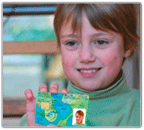 Belgium’s kids-ID can be used as an official travel document in most European countries as well as for traveling to some countries outside Europe, replacing the current Belgian ID certificate. The child must be traveling with a parent in possession of a valid ID card.
The cards also serve to protect the child if he runs into danger. Printed on the card body is a special hotline number used to notify the next of kin or a friend if the child is lost or is the victim of an accident.
When the card is issued, the parent or guardian goes on the Web or dials the hotline number and supplies a list of up to seven contact telephone numbers of adults who will take responsibility for the child.
These could include parents’ cell phone, office and home numbers. The emergency notification system hotline number is called, the caller is required to enter the child’s 11-digit National Registry number. They are then put through to the first person on the list–normally the child’s parent or guardian. If this person is not available, the caller is immediately connected to the second number on the list, and so on until somebody is located. If, in the unlikely event nobody on the list is available, the call is then immediately transferred to the 24-hour Belgian Child Focus hotline.
Thanks to an integrated PIN, the kids-ID card can also be used on the Internet for safer access to online chat rooms and to use online services that require ID. This authentication certificate can be issued at the age of six. The cards are available to all Belgian children aged 12 and under and open up a whole range of future possibilities. Other potential uses could include accessing library books, sport club memberships or health care benefits.
Future of UK ID scheme questionable
 The UK hadn’t had a national ID program in more than 50 years, but after a series of terrorist attacks at the start of the decade the country decided it was time to introduce the ID once again.
The UK Home Office stated that the cards would help protect people from identity fraud and theft, tackle illegal working and immigration abuse, disrupt the use of false and multiple identities by criminals and those involved in terrorist activity, ensure free public services are only used by those entitled to them and enable easier access to public services.
The program was originally planned to be mandatory for all citizens and foreign nationals but opposition lead to change. Now it looks like the program will only be mandated for foreign nationals and voluntary for everyone else.
In early October, British Prime Minister Gordon Brown seemed to clear up some confusion saying the compulsory ID cards wouldn’t be rolled out before 2015. There was speculation that if Brown’s Labour Party was voted out of office the program would most likely be scrapped by the Conservatives.
The program originally was supposed to collect fingerprint, face and iris biometrics from individuals, says John Elliott, head public sector practice and principal consultant at UK-based Consult Hyperion. But because of the economic downturn, the use of iris was eliminated to save money. “But now we are confused because their original reasoning for needing iris in the database was that you can’t do this with fingerprint alone because you might not be able to distinguish between 60 million people,” he says.
As a minimum, the card will store the ICAO application that’s used in electronic passports so it could be used for travel around Europe, It may store other applications, as well, but this has still not been decided, despite the several years the program has been in development.
Elliott says the program will most likely advance but slowly. Political parties out of power are against it and those in power are for it. The parties changed opinions several times over the past years but despite political opposition to the program public polls show support for it. “The government has done a poor job of selling it,” he says, “but polls show there isn’t a big public resistance.”